Dust poses a persistent environmental and occupational challenge in Saudi Arabia, far beyond being a simple nuisance. Frequent dust storms and desert conditions increase airborne particulate matter, creating hazards that range from respiratory issues to equipment degradation.
Understanding dust and particulate matter
Dust refers to fine solid particles suspended in the air, often classified by size. PM10 and PM2.5 are common categories, representing particles smaller than 10 micrometers and 2.5 micrometers respectively. These particles can penetrate deep into the lungs and even enter the bloodstream, posing health risks. Regulatory frameworks aim to limit the concentration of these airborne particles in urban, industrial, and construction zones.
Regulatory framework in Saudi Arabia
The Kingdom’s Environmental Law serves as the comprehensive national framework governing environmental protection, sustainable resource use, pollution control, and environmental permits, ensuring that activities with environmental impacts are regulated and licensed. Under this law, the Ministry of Environment, Water and Agriculture (MEWA) oversees enforcement and licensing, and violations can result in significant penalties including fines and permit suspensions.
Complementing this national framework are the Executive Regulations for Air Quality, adopted in May 2021, which set detailed standards and procedures to protect air quality, limit emissions, reduce degradation, and ensure sustainable development as required by the Environmental Law.
Regional entities also issue their own environmental and permitting regulations within their jurisdictions, and major developments like giga‑projects must align with both national laws and project‑specific environmental requirements. Saudi Arabia is also engaged in international conventions related to environmental protection and air quality, further situating the Kingdom’s regulatory approach within broader global standards.
RCRC Requirements
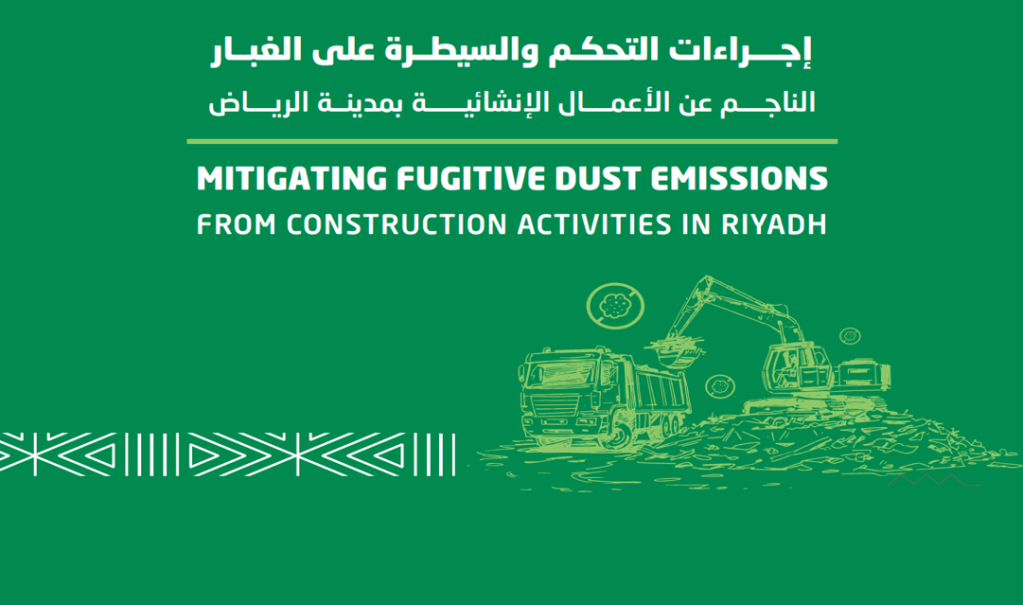
The Royal Commission for Riyadh City (RCRC) has formalized a mandatory framework titled Mitigating Fugitive Dust Emissions from Construction Activities in Riyadh, which applies to all construction projects with a total site area of 2,000 m² or more. Developed in cooperation with the National Center for Environmental Compliance (NCEC) and Riyadh Municipality, the framework strengthens local implementation beyond general air-quality law.
RCRC’s framework includes several key requirements. Projects must use certified dust suppression materials and spray or treat exposed surfaces daily to prevent dust from becoming airborne. Materials entering or leaving construction sites must be properly covered to avoid dust release during transport. Real-time on-site air quality monitoring devices are required, integrated with Riyadh’s unified construction dust monitoring platform, ensuring continuous oversight and rapid response to elevated particulate levels.
Environmental Compliance
These measures are not ad hoc; they are part of broader environmental mitigation requirements that are identified early in the project lifecycle during the Environmental Impact Assessment stage, before construction begins. At this stage, potential impacts such as dust emissions are assessed, and appropriate controls are formalized within environmental management plans that guide construction activities.
Developers must submit periodic performance reports demonstrating compliance, and dust suppression plans must balance emissions control with responsible water use to avoid unnecessary resource consumption. Non-compliance can result in fines of up to SAR 50,000 per violation, reflecting a proactive and enforceable regulatory approach that links early-stage environmental planning with on-the-ground implementation.
 The Environment Consultant