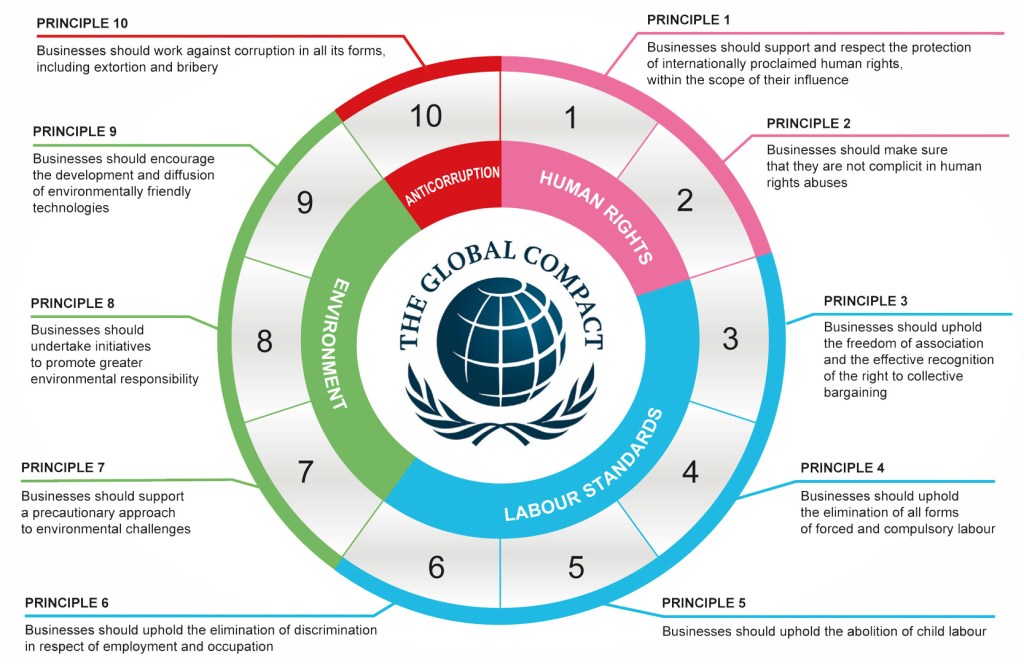
The United Nations Global Compact was launched in 2000 as a voluntary initiative by the United Nations to encourage businesses worldwide to adopt sustainable and socially responsible policies. It introduced ten principles covering human rights, labour, environment, and anti-corruption, drawing from established UN conventions.
UNGC has grown into one of the largest and most widely recognised corporate sustainability initiatives, with thousands of participating companies across more than 160 countries. It promotes alignment between business practices and global development goals, including the Sustainable Development Goals introduced in 2015, while also providing a platform for learning, collaboration, and engagement with evolving international standards.
Ten principles and focus areas
The UNGC principles are grouped into four broad categories:
- Human rights – Respect and support internationally recognised human rights within the organisation and its supply chain.
- Labour standards – Uphold freedom of association, eliminate forced or child labour, and promote safe, fair working conditions.
- Environment – Support a precautionary approach to environmental challenges, promote sustainable practices, and encourage environmental responsibility throughout the value chain.
- Anti-corruption – Work against corruption in all forms, including bribery and extortion.
This comprehensive approach encourages organisations to consider not just financial or environmental impacts, but also the social and ethical implications of their business practices.
Commitment
Organisations participating in UNGC commit to integrating these principles into their operations and reporting on progress annually through Communication on Progress (COP) reports, demonstrating transparency and accountability. UNGC is often used in combination with other reporting frameworks like GRI or SASB, allowing organisations to meet broader sustainability reporting expectations while maintaining a focus on ethical and social responsibility.
 The Environment Consultant