The Taskforce on Nature-related Financial Disclosures (TNFD), launched in 2021, was established to address the growing financial risks arising from nature loss. Companies across many sectors depend on natural systems such as water, fertile soil, forests, and healthy oceans, yet the degradation of these ecosystems has historically been poorly measured and insufficiently disclosed, despite its potential to disrupt supply chains, increase costs, and threaten long-term profitability.
TNFD provides a standardized framework that translates businesses’ interactions with nature into financially material information, enabling better corporate and investment decisions and supporting the alignment of capital markets with global biodiversity and sustainability goals.
TNFD Approach
Setting the Foundation: Governance and Leadership Buy-in
The TNFD framework is structured around a four-stage process commonly referred to as LEAP (Locate, Evaluate, Assess, and Prepare/Disclose). Before a company starts LEAP, it needs leadership support because nature-related risks cut across the whole organization.
This usually involves:
- Assigning a senior sponsor (e.g., CFO, Chief Sustainability Officer, or Board committee) to oversee nature-related risk management.
- Defining roles across teams: environmental specialists, risk management, finance, procurement, and operations.
- Integrating nature into existing enterprise risk management (ERM) and sustainability reporting structures so it’s not treated as a silo.
This ensures that when LEAP is applied, the findings can influence strategic decisions, budgets, and investment planning.
LEAP in Practice
The LEAP framework has four stages: Locate → Evaluate → Assess → Prepare/Disclose, and companies usually tackle them iteratively. Each step integrates ecological and financial considerations to produce actionable insights.
- Locate involves mapping the organization’s operations, supply chains, and sourcing regions against exposure to critical ecosystems and biodiversity hotspots. This spatially explicit approach identifies where corporate activities intersect with ecologically sensitive areas, enabling prioritization of material sites and suppliers.
- Assess quantifies dependencies and impacts on nature, measuring the potential influence of ecological change on operational continuity and financial performance. Assessment includes evaluating metrics such as water stress, land-use conversion, habitat fragmentation, and species vulnerability. TNFD encourages using both qualitative and quantitative indicators to capture risks that may not yet have market or regulatory signals but could have future financial implications.
- Evaluate translates ecological data into financial and strategic risk terms. Organizations estimate how nature-related risks could affect revenue, costs, capital expenditure, or asset valuation. Scenario analysis is recommended to explore uncertainties, including changes in regulatory frameworks, climate interactions, and market shifts. This step ensures that identified nature risks are assessed for materiality, aligning environmental considerations with enterprise risk management processes.
- Prepare/Disclose provides a standardized structure for reporting findings to investors, lenders, and stakeholders. TNFD encourages transparent, decision-useful reporting of dependencies, impacts, risk management strategies, and forward-looking metrics. Disclosure integrates ecological thresholds and financial materiality, enabling comparability across sectors and geographies while supporting market confidence in nature-related risk management.
Integrating LEAP into Governance
Organizations adopting TNFD typically integrate the framework into existing governance structures, risk management systems, and sustainability reporting cycles. Cross-functional collaboration is essential, involving environmental teams, finance, operations, and procurement. Integration happens on several levels:
- Board and Committees: Ensure nature-related risks are discussed alongside financial, operational, and climate risks.
Executive Teams: Link LEAP findings to budgeting, capital allocation, and strategy. - Operational Teams: Embed nature metrics in procurement, manufacturing, and site management decisions.
- Risk and Audit Functions: Include nature-related KPIs in risk registers, internal audits, and ESG reporting cycles.
This LEAP integration into existing governance structures allows companies to ensure that nature-related insights are not just a report, but actually influence decision-making, risk mitigation, and long-term strategy.
Global Adoption
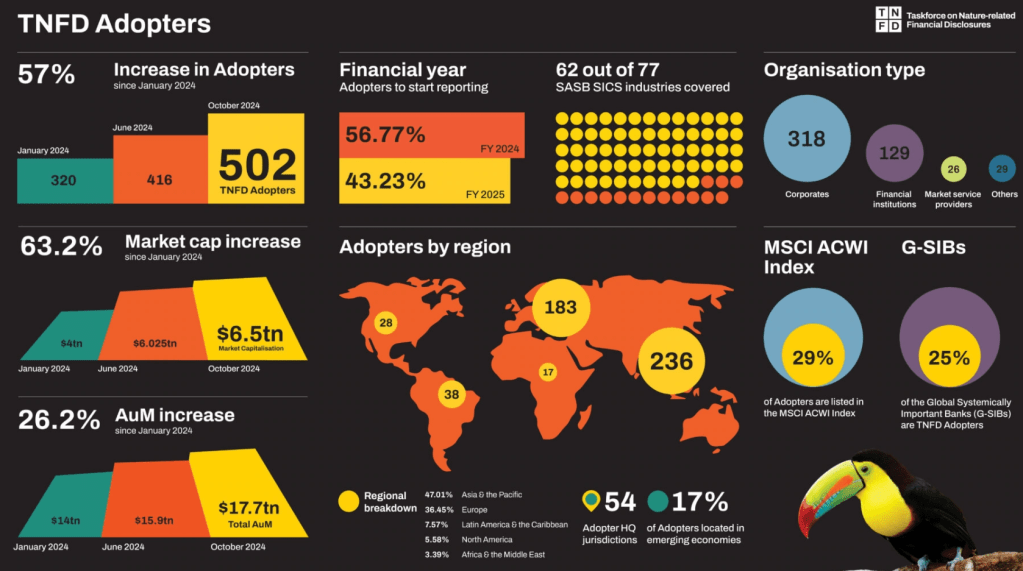
TNFD market adoption has grown rapidly. As of late 2025, more than 730 organizations have committed to begin nature-related corporate reporting aligned with TNFD guidance. These companies represent over USD 9 trillion in market capitalization, and financial institutions managing over USD 22 trillion in assets under management.
The existing TNFD framework is expecting a formal transformation into an official Sustainability Disclosure Standard, based on a recent collaboration announced between TNFD and the International Financial Reporting Standards (IFRS) Foundation in April 2025.
 The Environment Consultant