
In most countries, the Environmental Impact Assessment (EIA) is the primary environmental decision-making tool for development projects. While details vary by jurisdiction, the overall structure is remarkably consistent across regions such as Europe, Latin America, Africa, the Middle East, and parts of Asia.
However, this is not the case in the United States (U.S.), as the country does not have a EIA system. Instead, the U.S. relies on a procedural environmental review law (NEPA) combined with multiple, media-specific environmental permits.
EIA System Worldwide
Environmental Impacts in most countries are controlled through EIA approval conditions, in a centralized manner. Under the typical global model, EIA is both an impact assessment tool, and a regulatory gatekeeper.
The EIA process usually follows these steps:
- Screening
The environmental authority determines whether an EIA is required based on project type and size. - Scoping
The authority approves Terms of Reference that define what environmental topics must be studied. - EIA Preparation
A single, comprehensive EIA is prepared by the project proponent and its consultants. - Public Consultation
The draft EIA is disclosed, public hearings are held, and comments are formally addressed. - Environmental Approval
The authority issues an Environmental License, Clearance, or Permit that approves (or rejects) the project, and sets binding environmental conditions. - Follow-On Permits
Construction and operational permits are often issued once the EIA is approved.
In this model, the EIA approval is the decisive step. Without it, the project cannot proceed. The process can be summarized as follows:
One document + approval → project proceeds
One EIA → one competent authority → one environmental approval → permits follow
U.S. System (NEPA)
The United States does not have a single, centralized EIA system or an integrated environmental permit. When a project is proposed for development, the first question is to define whether there is federal involvement. This includes federal funding or loans, federal land or property use, federal permits or approvals (e.g., Clean Water Act Section 404 for wetlands).
Two paths then emerge:
Path A: Federal Involvement → NEPA + Permits
NEPA, or National Environmental Policy Act of 1969, is a foundational environmental law in the United States. NEPA’s main goal is to ensure that federal agencies consider environmental impacts before making decisions about major projects or actions. In the U.S., environmental impacts are controlled through permits issued under separate laws. NEPA references these requirements, but the permits are what legally bind the project.
1. NEPA Process (Assessment and Disclosure)
The federal lead agency determines the level of NEPA review:
- Categorical Exclusion (CATEX) → minimal impact, no detailed study
- Environmental Assessment (EA) → concise study, may lead to FONSI
- Environmental Impact Statement (EIS) → comprehensive study, leads to Record of Decision (ROD)
Public participation and inter-agency consultations occur, and NEPA ensures environmental impacts are considered and disclosed, but it does not approve or reject the project.
2. Media-Specific Laws and Other Permits (Approval and Control)
In the U.S., the environmental regulation is “media-specific”, meaning laws target particular environmental media (air, water, land, species, etc.) rather than providing a single, unified environmental approval.
After or alongside NEPA, the project must obtain binding environmental permits from federal and sometimes state agencies.
Examples:
- Air → Clean Air Act permits
- Water → Clean Water Act NPDES or Section 404 permits
- Waste → RCRA hazardous waste permits
- Species & habitat → Endangered Species Act consultations
Only after these permits are secured can construction or operation legally begin.
The process can be summarized as follows:
NEPA = assessment and disclosure; permits = approval and impact control
Many permits → many agencies → NEPA is a disclosure process, not an approval
Path B: No Federal Involvement → Permits Only
The project does not trigger NEPA, because there is no federal connection. The project still must comply with media-specific environmental laws at the state or local level, which often mirror federal laws.
Example: A private industrial facility discharging wastewater may need a state-issued NPDES permit even without federal involvement.
Some states have their own EIA-equivalent requirements (e.g., CEQA in California, SEQRA in New York) that act like NEPA but at the state level.
The U.S. system has been developed this way because, historically:
- NEPA was enacted first (1970),
- Media-specific environmental laws followed,
- U.S. governance favors sectoral authority,
- Courts enforce process compliance, not environmental outcomes.
The result is a procedural + permit-based environmental system, rather than an approval-based EIA model. NEPA does not approve nor reject a project, does not set emission limits nor environmental standards, and does not control the actual environmental impacts. Instead, NEPA focuses on the process, making sure decisions are informed by environmental information.
Reporting: EIA System vs. NEPA Model
Reporting under the EIA System
In a conventional EIA system, reporting is a formal, structured process directly linked to project approval. Overall, reporting is sequential, regulated, and central to both decision-making and environmental accountability. The process begins with:
- The Terms of Reference (ToR), which defines the scope, methodology, and key issues for study and must be approved by the authority before work begins.
- Next comes scoping, often involving stakeholder input, to identify significant environmental issues and guide the focus of the EIA.
- The EIA report itself presents a detailed analysis of the project, baseline conditions, potential impacts, alternatives, and proposed mitigation measures.
- This report is submitted to the competent authority, followed by public consultation where stakeholders provide feedback. The authority then reviews all inputs and issues a decision – approving, conditionally approving, or rejecting the project.
- Finally, post-approval reporting ensures that mitigation measures are implemented and monitored, with regular submissions demonstrating compliance.
Reporting under NEPA
In the U.S., what counts as reporting is embedded in the NEPA process, but it is not structured like a conventional EIA report with ToR approval first. Here’s how it typically works:
1. No formal ToR process
In many countries, the ToR is submitted first, which is then reviewed and approved by the authority before the EIA study starts. In the U.S., there’s no formal ToR submission.
Instead, the lead federal agency (overseeing the media-specific laws) defines the scope of the study internally, often after an early consultation period with other agencies and the public. This scoping is more of a guidance step than an approval step.
2. Scoping is part of the NEPA process
If an Environmental Impact Statement (EIS) is required, the agency conducts public scoping to identify key issues. This is usually done via a Notice of Intent (NOI) published in the Federal Register.
The public, stakeholders, and other agencies can comment on what impacts should be considered. Scoping is advisory, and not a formal approval of the study plan.
3. Preparation of the NEPA document
Depending on the level of review, the key reporting feature include:
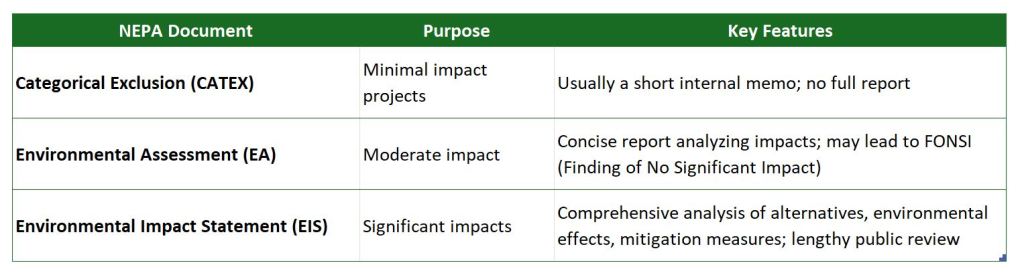
The NEPA document itself acts as the “report”, and it discloses impacts but does not approve or permit the project.
4. Public and inter-agency review
The draft EIS is published for public comment (typically 45 days for federal projects). Agencies respond to comments in the Final EIS (FEIS). Then the agency issues a Record of Decision (ROD), which formally documents the agency’s decision and mitigation requirements.
5. Permits and compliance reporting
Separately, the project must obtain binding permits (Clean Air Act, Clean Water Act, etc.). Each permit typically has its own reporting requirements, such as monitoring reports, emission or discharge logs, and compliance certifications. Thus, the “reporting” that enforces environmental standards mostly happens through permit compliance, not NEPA.
 The Environment Consultant