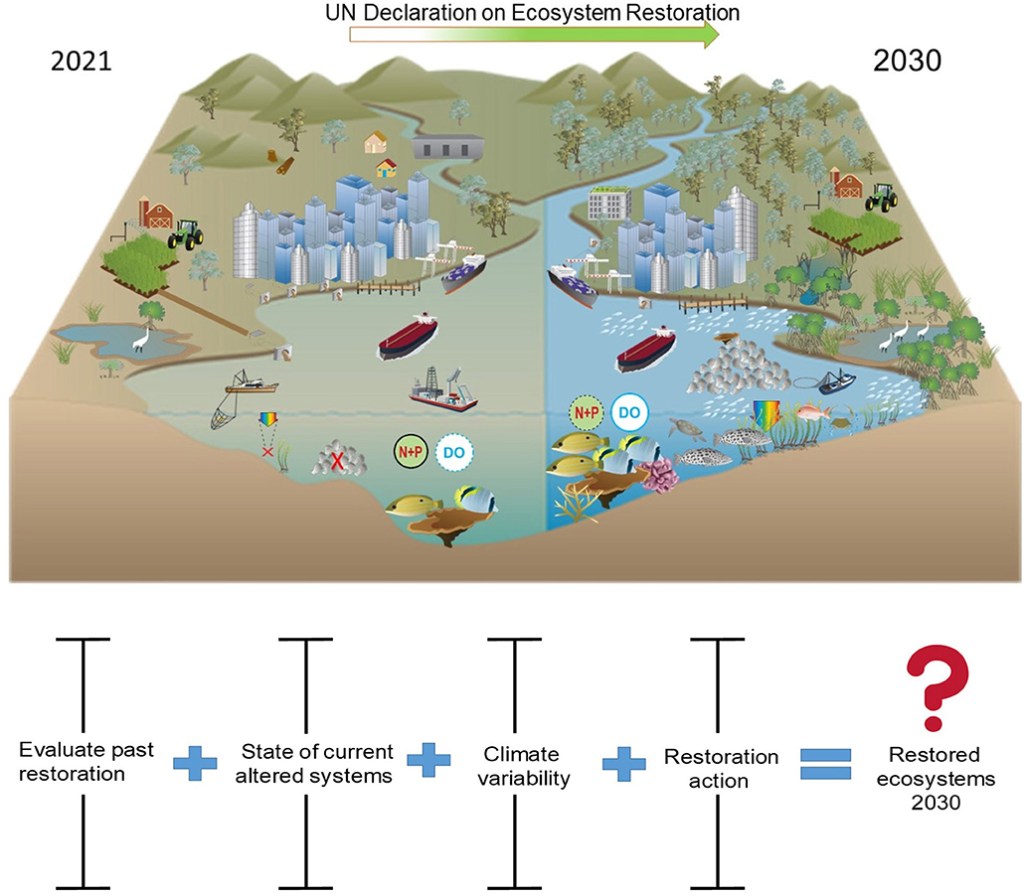
Overview of a coastal restoration approach, as discussed in Waltham et al., 2020.
Human activities such as urbanization, intensive agriculture, deforestation, overgrazing, pollution and climate change are the major drivers for habitat loss and degradation, consequently leading to biodiversity decline worldwide.
Restoration ecology focuses on the recovery of degraded, damaged, or destroyed ecosystems to re-establish their structure, function, and biodiversity. The primary objective of restoration is not merely to reintroduce species but to re-establish ecological processes such as nutrient cycling, hydrological balance, and natural successional dynamics.
Restoration efforts are guided by ecological principles, including the identification of reference ecosystems, assessment of site-specific conditions, and consideration of the interactions among biotic and abiotic components.
This article explores the key techniques used in habitat restoration and highlights real-world case studies demonstrating their practical applications.
Approaches to Recovering Degraded Ecosystems
Site Assessment and Baseline Evaluation
Effective restoration begins with comprehensive site assessment, which informs the selection of techniques and strategies. Baseline evaluation typically includes soil analysis, hydrology assessment, vegetation surveys, and identification of native and invasive species. Historical land use, disturbance regimes, and surrounding landscape connectivity are also critical factors.
Understanding these parameters allows practitioners to define restoration goals, such as enhancing habitat for particular species, improving soil fertility, or mitigating erosion, and ensures that interventions are ecologically appropriate and sustainable.
Soil and Hydrological Management
Degraded soils often require interventions to restore fertility, structure, and microbial communities. Techniques such as mulching, compost addition, mycorrhizal inoculation, and erosion control measures improve soil health and promote vegetation establishment.
Hydrological restoration is also critical, particularly in landscapes impacted by drainage, water extraction, or altered flow regimes. Reconstructing natural channels, establishing swales, and implementing rainwater harvesting can restore hydrological function and support vegetation growth, thereby enhancing overall ecosystem resilience.
Selection of Native Species and Planting Strategies
The choice of native flora is central to successful restoration. Native species are adapted to local environmental conditions, support native fauna, and maintain ecosystem functions. In arid and semi-arid regions such as the Arabian Peninsula, species such as Vachellia (Acacia trees) provide critical habitat for birds, insects, and small mammals. Seed sourcing from local populations maintains genetic diversity and increases establishment success.
Planting strategies must consider species-specific requirements, including spacing, soil amendments, and microhabitat creation. Techniques such as direct seeding, containerized seedlings, and nurse-plant facilitation are applied according to site conditions and restoration objectives.
Control of Invasive Species
Invasive species can impede restoration by outcompeting native flora and fauna and altering ecosystem processes. Effective management includes mechanical removal, targeted herbicide application, and long-term monitoring. Restoration practitioners often combine invasive control with the reintroduction of competitive native species to ensure sustained recovery.
Active Revegetation
Active revegetation involves the planting of native species to re-establish vegetation cover. This technique is particularly useful in areas where natural regeneration is insufficient due to soil degradation, invasive species, or altered hydrological conditions. Selection of plant species should consider local ecological conditions, species interactions, and long-term resilience.
Assisted Natural Regeneration
Assisted natural regeneration (ANR) supports the natural recovery processes by creating favorable conditions for native species to re-establish. This approach can include protecting seedlings from grazing, pruning competing vegetation, or enriching the seed bank. ANR is often cost-effective and leverages existing ecological processes, making it a preferred method in large-scale restoration projects.
 The Environment Consultant