
Pollinator Lesser Long-nosed Bats (Leptonycteris curasoae).
Pollinators, including bees, butterflies, other insects, birds and mammals such as bats, play a fundamental role in maintaining ecosystem functionality and biodiversity. They facilitate the reproduction of a vast array of flowering plants, which underpins food production, habitat structure, and genetic diversity.
Declines in pollinator populations have been documented globally, attributed to habitat loss, pesticide use, climate change, and disease. The resulting disruption of pollination services can compromise both natural ecosystems and agricultural productivity, highlighting the urgency of effective conservation strategies.
Pollination and Ecosystem Services
Pollination is a key regulating ecosystem service that directly influences food security, forest regeneration, and carbon sequestration. Approximately 75% of global food crops rely, at least in part, on animal-mediated pollination. In natural ecosystems, pollinators maintain plant reproductive success, promote genetic diversity, and enhance resilience to environmental stressors.
Consequently, declines in pollinator populations can lead to cascading effects, including reduced fruit and seed production, altered plant community composition, and compromised ecosystem stability.
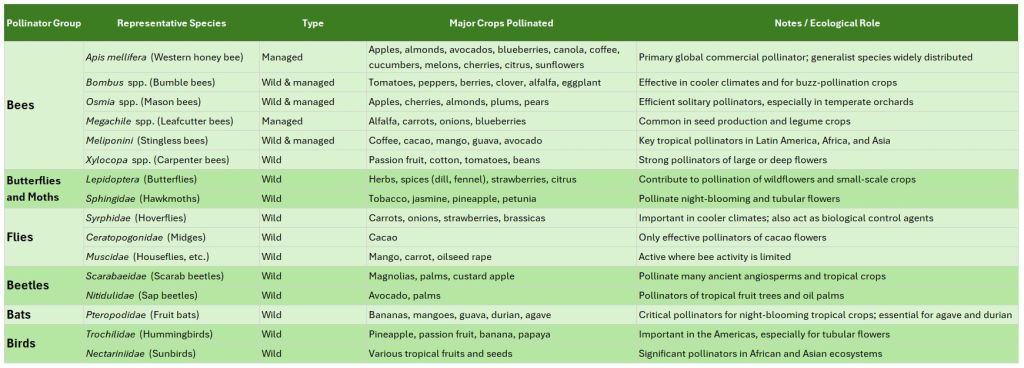
Example of pollinator groups, representative species and major crops.
Pollinator Threats
Pollinators face multiple interacting threats that have contributed to global declines. Habitat loss and fragmentation, driven by agriculture, urbanization, and deforestation, reduces access to nesting sites and diverse floral resources, isolating populations and limiting foraging options.
Pesticide exposure, including neonicotinoids and other insecticides, causes both lethal and sublethal effects, impairing navigation, reproduction, and immunity, while herbicides indirectly reduce food availability.
Diseases and parasites further undermine pollinator health; pathogens such as mites, fungi, and viruses weaken both managed and wild species, often interacting with other stressors.
Nutritional stress from monocultures and loss of wildflower-rich habitats reduces dietary diversity, weakening resilience. Climate change exacerbates these challenges by disrupting flowering times, altering species distributions, and increasing extreme weather events.
Additional pressures include invasive species, which compete with or prey on native pollinators, and intensive agricultural practices, which can spread disease and reduce genetic diversity. Pollution, such as air and light pollution, also interferes with foraging behavior.
Together, these threats act synergistically, emphasizing the need for habitat restoration, sustainable land use, pesticide regulation, and the conservation of pollinator diversity to maintain ecosystem services.
Approaches to Pollinator Conservation
Conservation strategies often integrate habitat protection, restoration, and sustainable management practices. Maintaining floral diversity, preserving nesting sites, and implementing buffer zones around agricultural areas can support pollinator populations.
Agroecological approaches, such as intercropping, hedgerow planting, and reduced pesticide use, provide additional benefits by creating continuous resources for pollinators. In urban and peri-urban landscapes, green infrastructure, community gardens, and pollinator corridors enhance connectivity between habitats, supporting both diversity and abundance.
Monitoring Pollinator Populations
Robust monitoring programs are critical for assessing population trends and evaluating the effectiveness of conservation measures. Field-based surveys, including transects, pan traps, and netting, provide quantitative data on species richness, abundance, and temporal activity patterns.
Remote sensing and citizen science platforms increasingly contribute to large-scale monitoring, allowing for timely detection of declines and spatial identification of key habitats. Integrating monitoring data with ecological models enables prediction of future trends under scenarios such as climate change or land-use modification.
Economic and Social Implications
Pollinator declines have substantial economic implications, particularly for agriculture. The loss of pollination services can reduce crop yields, increase production costs, and compromise food security. Additionally, pollinator-driven ecosystem services contribute to cultural and recreational values, supporting livelihoods and sustaining human well-being.
 The Environment Consultant