Biodiversity loss has become one of the most pressing environmental challenges of the twenty-first century. The continued degradation of ecosystems, the accelerated extinction of species, and the disruption of ecological processes threaten the foundations of human well-being and planetary stability.
In response to this escalating crisis, the international community, under the Convention on Biological Diversity (CBD), adopted the Kunming–Montreal Global Biodiversity Framework (GBF) in December 2022 during the UN Biodiversity Conference of the Parties (COP15).
The GBF builds upon lessons learned from the previous Strategic Plan for Biodiversity (2011–2020) and its Aichi Biodiversity Targets, which fell short of full implementation. The new framework provides a unified global strategy for halting and reversing biodiversity loss by 2030 and achieving a long-term vision of “living in harmony with nature” by 2050.
The following sections provide a concise technical summary of each part of the framework, highlighting its structure, content, and policy implications.
Section A: Background
The background section of the GBF outlines the global context that led to its development, and reflects on the partial achievements and gaps of the Aichi Targets. It calls for urgent, coordinated action across all sectors of society to address the drivers of biodiversity loss and to secure ecological resilience.
Section B: Purpose
This section defines the purpose of the framework as a global instrument to guide and coordinate biodiversity conservation, sustainable use, and equitable benefit-sharing. It operationalizes the three core objectives of the Convention on Biological Diversity: (1) the conservation of biological diversity, (2) the sustainable use of its components, and (3) the fair and equitable sharing of benefits arising from genetic resources.
The GBF is intended to serve as a common reference for updating and implementing National Biodiversity Strategies and Action Plans (NBSAPs). It is designed to be action-oriented, measurable, and adaptable to national circumstances while ensuring coherence with other international environmental agreements.
Section C: Considerations for Implementation
The framework includes a set of cross-cutting considerations that guide its implementation, with principles that emphasize the full respect for the rights, knowledge, and practices of Indigenous Peoples and Local Communities (IPLCs), along with gender equality, youth engagement, and the inclusion of both scientific and traditional knowledge.
Section D: Relationship with the 2030 Agenda for Sustainable Development
Section D establishes the connection between the GBF and the United Nations 2030 Agenda for Sustainable Development. It recognizes that achieving the Sustainable Development Goals (SDGs) depends on healthy and resilient ecosystems, and conversely, that progress toward the SDGs creates the conditions necessary to achieve the framework’s biodiversity goals.
The GBF positions biodiversity as an integral component of sustainable development, linking conservation with poverty reduction, food security, and economic stability.
Section E: Theory of Change
The section starts with the understanding that addressing biodiversity loss requires immediate action to reduce or reverse drivers of degradation. The framework then envisions a global change and transition toward sustainability, in which societies reform their production and consumption patterns, strengthen governance systems, and restore degraded ecosystems.
If these systemic changes occur, biodiversity can recover, species populations can stabilize, and the ecological functions that support life can be maintained.
Section G: Global Goals for 2050
The GBF establishes four long-term global goals for achievement by 2050.
- Goal A seeks to ensure that the integrity, connectivity, and resilience of all ecosystems are maintained, enhanced, or restored, and that human-induced extinction is halted. The goal also aims to increase the abundance of native species and to improve the conservation status of threatened species.
- Goal B focuses on the sustainable use and management of biodiversity and on maintaining and enhancing nature’s contributions to people, including ecosystem services and cultural values.
- Goal C promotes the fair and equitable sharing of benefits arising from the utilization of genetic resources, including benefits associated with traditional knowledge.
- Goal D addresses the means of implementation by ensuring that adequate financial resources, capacity-building, scientific cooperation, and technology transfer are available to support the achievement of the framework’s objectives.
Section H: Global Targets for 2030
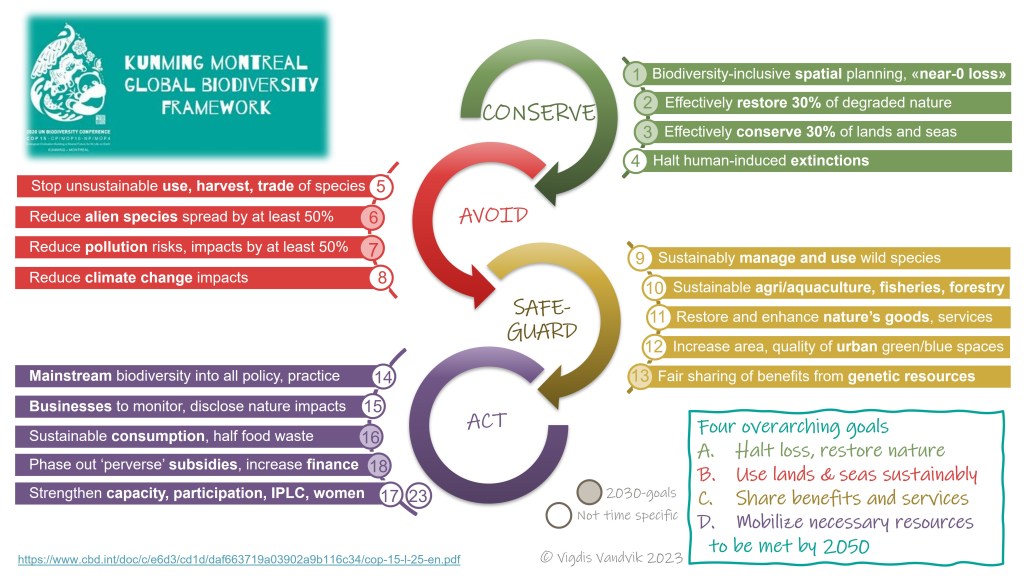
To advance toward the 2050 goals, the framework includes 23 action-oriented targets to be achieved by 2030. These targets address critical areas such as ecosystem conservation, restoration, sustainable resource management, pollution reduction, and financing.
Two flagship targets have received particular attention:
- Target 2 calls for the restoration of at least 30 percent of degraded terrestrial, inland water, and marine ecosystems.
- Target 3 commits to ensuring that at least 30 percent of the planet’s land and ocean areas are effectively conserved by 2030.
Other targets focus on reducing pollution risks, controlling invasive alien species, promoting sustainable agriculture, and requiring companies to disclose their impacts on biodiversity. Collectively, the targets serve as measurable milestones for tracking global progress.
Section I: Implementation, Monitoring, and Resource Mobilization
The implementation section outlines the mechanisms through which the GBF will be executed. It introduces an enhanced planning, monitoring, reporting, and review process, requiring countries to align their NBSAPs with the global framework and to submit periodic reports on progress. A global monitoring framework provides indicators for evaluating implementation.
Resource mobilization is a central element of this section. The framework calls for a substantial increase in financial resources from all sources, including public, private, and philanthropic funding.
It also highlights the need to make financial flows consistent with biodiversity objectives and to support developing countries and IPLCs in their conservation efforts. Furthermore, this section promotes capacity development, scientific cooperation, and technology transfer as essential tools for achieving the framework’s targets.
Conclusion
The Kunming–Montreal Global Biodiversity Framework represents a comprehensive and ambitious international policy instrument aimed at halting and reversing biodiversity loss. It combines scientific evidence, policy mechanisms, and social inclusion into a coherent global strategy.
The GBF provides a clear and measurable roadmap for global action. Its success will depend on effective national implementation, adequate resource mobilization, and transparent monitoring. The framework’s transformative ambition, if realized, has the potential to redefine humanity’s relationship with nature and to secure the ecological foundation upon which sustainable development depends.
 The Environment Consultant