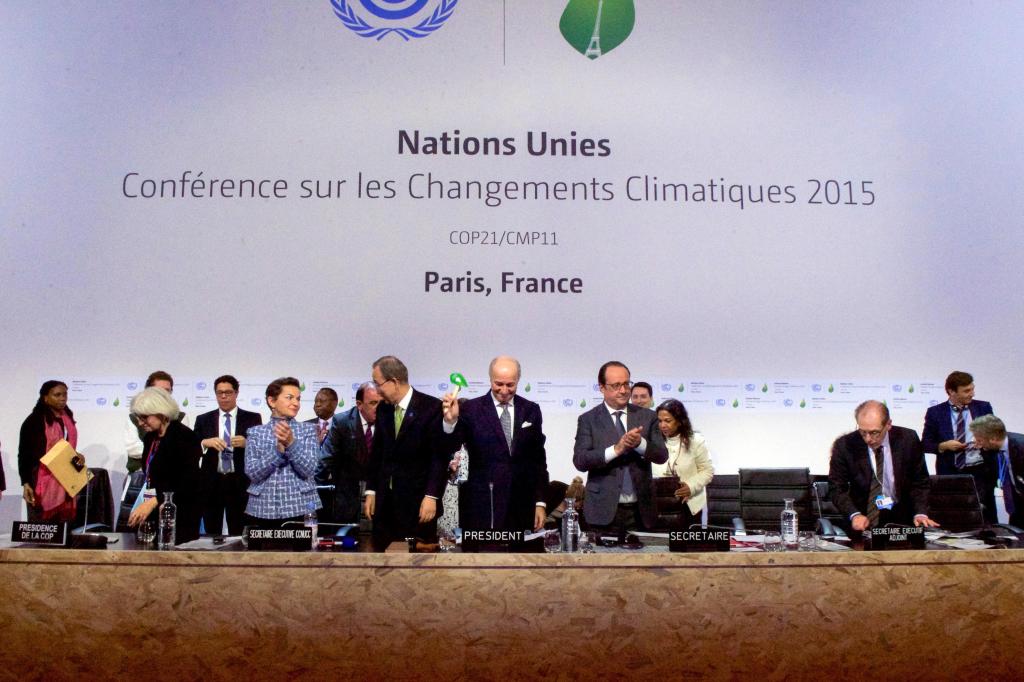
Adopted in December 2015 at COP21, the Paris Agreement marked a historic turning point in international climate governance. It brought together nearly every country in the world under a shared, legally binding commitment to limit global warming and pursue a more resilient, low-carbon future.
Unlike previous climate treaties, the Paris Agreement is built on a flexible, bottom-up structure, allowing each country to define its own climate ambitions while being held accountable through transparency and periodic review.
Nearly a decade later, the Paris Agreement remains the central architecture for global climate cooperation, and its principles continue to shape domestic and international climate policy across sectors and regions.
What makes the Paris Agreement unique?
The Paris Agreement stands apart from earlier frameworks like the Kyoto Protocol in several key ways:
- Universal participation: As of 2025, 195 countries and the EU have ratified the Agreement, covering over 99% of global emissions.
- Temperature goal: A collective commitment to limit global warming to well below 2°C above pre-industrial levels, with efforts to stay below 1.5°C.
- Nationally Determined Contributions (NDCs): Countries submit their own emissions reduction plans, which are updated every five years, allowing for increased ambition over time.
- Transparency and accountability: A standardized Enhanced Transparency Framework requires countries to report emissions and progress, fostering trust and comparability.
- Global stocktake: Every five years, countries collectively assess progress toward the long-term goals, with the first full stocktake concluding in 2023 at COP28.
- Climate finance and adaptation: Developed countries are expected to mobilize at least USD 100 billion annually to support mitigation and adaptation in developing countries.
- Recognition of non-state actors: Cities, companies, investors, and civil society are explicitly encouraged to contribute to the Agreement’s goals.
Progress Since 2015
While the Agreement’s success hinges on long-term transformation, several key milestones and performance indicators (KPIs) offer insight into global progress:
- NDC Coverage: As of 2025, all Parties have submitted at least one NDC, and over 140 countries have updated or enhanced theirs to reflect higher ambition.
- Net-zero commitments: Over 90% of global GDP is now covered by some form of net-zero pledge, with the EU (2050), China (2060), and India (2070) among the most notable.
- Climate finance: The USD 100 billion target has been nearly met, though debates continue about its composition, accessibility, and adequacy. A new collective finance goal beyond 2025 is under negotiation.
- Global stocktake: The first global stocktake (2023) confirmed that while progress is being made, current policies and NDCs remain insufficient, placing the world on a trajectory of 2.4–2.6°C warming without stronger action.
National Alignment and Policy Integration
Countries have adopted diverse approaches to aligning their domestic policies with the Paris framework:
- European Union: Legally binding climate targets, including the EU Climate Law and Fit for 55 (at least 55% emission reductions by 2030) package, are explicitly designed to meet Paris goals.
- United States: After rejoining the Agreement in 2021, the U.S. committed to cutting emissions 50–52% by 2030 from 2005 levels, backed by landmark legislation like the Inflation Reduction Act.
- China: While still reliant on coal, China’s inclusion of carbon pricing national ETS, clean energy expansion, and net-zero by 2060 signal long-term alignment.
- Developing countries: Nations such as Costa Rica, Chile, Kenya, and Morocco are integrating climate ambition into national development plans, supported by international finance and capacity building.
Still, implementation gaps persist, particularly in aligning short-term policies with long-term targets, addressing adaptation needs, and phasing out fossil fuel subsidies. As the Agreement enters its second decade, scientific evidence continues to highlight the urgency of deeper and faster cuts in greenhouse gas emissions.
 The Environment Consultant