The Carbon Border Adjustment Mechanism (CBAM) is a pioneering policy tool introduced by the European Union to complement its domestic climate ambitions under the European Green Deal and the EU Climate Law.
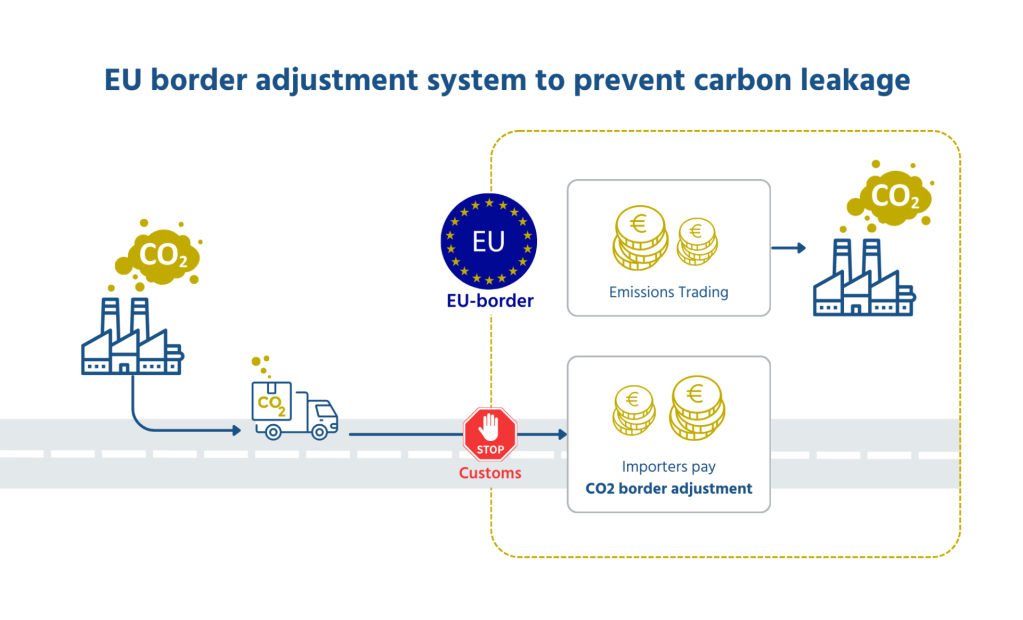
Designed to prevent carbon leakage, where companies might relocate production to countries with less stringent climate policies, CBAM aims to level the playing field by ensuring that imported goods face a carbon price equivalent to that paid by EU producers under the Emissions Trading System (ETS).
How CBAM Works
CBAM applies a carbon price on imports of selected goods from outside the EU, calculated based on the embedded greenhouse gas emissions associated with their production. Initially, it targets carbon-intensive sectors such as cement, iron and steel, aluminum, fertilizers, and electricity generation.
Importers must purchase CBAM certificates corresponding to the carbon emissions embedded in their products, effectively mirroring the EU ETS carbon price. By doing so, CBAM aims to:
- Prevent carbon leakage by reducing the incentive for companies to relocate production to regions with lower climate ambitions.
- Encourage decarbonization in third countries by incentivizing cleaner production methods for goods exported to the EU.
- Protect the competitiveness of EU industries subject to carbon costs.
CBAM is undergoing a transitional phase starting in 2023, initially requiring only reporting and transparency without financial obligations. Full implementation will begin in 2026, when importers must start purchasing CBAM certificates. The mechanism covers sectors responsible for significant emissions and trade volumes and may expand over time to additional goods and sectors.
The system requires rigorous emissions accounting and verification for imported goods, which presents technical challenges, but is critical to maintaining the environmental integrity and fairness of the mechanism.
Scientific and Policy Implications
CBAM is an important development in the intersection of climate policy, trade, and carbon accounting. It raises key questions about how to accurately measure and verify embedded emissions, the potential impacts on global supply chains, and the broader implications for international climate cooperation.
CBAM’s success depends on transparent data, robust methodologies, and ongoing dialogue with trading partners to align climate ambitions and avoid trade disputes. It represents a novel approach to addressing the global nature of carbon emissions while protecting regional climate progress.
 The Environment Consultant