This articles describes the key findings of the 2024 Natural Capital Assessment of Colombian’s Sinú River Basin, conducted by the National Planning Department in collaboration with the Natural Capital Project of Stanford University.
What researchers found is that ecosystems in the basin provide more than $100 million USD worth of sediment retention services every year.
In simple terms, forests and soil reduce erosion, which keeps rivers cleaner and protects dams and turbines from clogging up with sediment. That means longer-lasting infrastructure, fewer maintenance costs, and more reliable electricity, without spending a dollar on new machinery.
The estimated natural capital equals about 1.7% of the region’s gross domestic product (GDP), showing that investing in nature protection can be just as valuable as investing in infrastructure – sometimes even more.
Project Site: Sinú River
The Sinú River is one of the major rivers in northern Colombia. Stretching approximately 415 kilometers, it flows from the Cordillera Occidental (Western Andes) down to the Caribbean Sea, cutting across lush valleys and tropical forests before reaching the coast.
The Upper Sinú River flows from forested highlands into a region that depends on hydropower and agriculture, with a population of around 1,295,469 people. The hydroelectric plant has an installed capacity of 340 megawatts (MW) and supplies approximately 2% of Colombia’s national energy demand.
Forests, including tropical rainforests and dry forests, cover about 22% of the Sinú River Basin, mainly in the upper basin near Paramillo National Park, where the river originates. The Sinú River supports key economic activities such as agriculture and cattle ranching, particularly along the Caribbean coast.
Agroecosystems dominate the landscape, making up 55% of the basin’s area. The coastal cities of Tolú and Coveñas are growing tourism centers known for their beaches, mangroves, and wetlands, currently undergoing rapid development.
Environmental threats
The Sinú River faces growing environmental pressure, such as:
- Deforestation, especially upstream, leads to soil erosion and increased sediment in the river.
- Damming and water diversion for energy and agriculture have changed natural flow patterns, affecting fish populations and wetlands.
- Pollution from agriculture and industry also threatens water quality.
Assessment Approach
1. Developing Natural Capital Accounts
The first step involved creating a list of ecosystem services and accounts based on the UN’s System of Environmental-Economic Accounting framework. These accounts incorporated both physical (e.g., extent area, tons of carbon capture) and monetary values, using survey data calibrated to the local context.
The study focused on the regulating ecosystem service of water quality through avoided erosion and sediment retention, as these services are essential for maintaining clean water flows to hydropower facilities and water utilities that serve households and businesses in the region.
2. Engagement with stakeholders
To ensure relevance and local applicability, the study included consultations with regional stakeholders such as utility managers, energy sector representatives, and local government officials.
Thought interviews, the researchers identified which ecosystem services are most valued locally, many of which have been historically overlooked in both financial accounting and policy-making processes.
3. Assessing future scenarios
Building on the initial accounts, the same data and modeling approach was used to evaluate how sediment retention values might change under future conditions. Scenarios explored include planned aqueduct expansion, changes in land use, population growth, and climate change.
4. Answer key policy questions
The assessment was structured to address three core policy questions:
- What is the current magnitude and economic value of sediment retention services for hydropower and water supply?
- Which geographic areas within the basin are most vital for ensuring water and energy security?
- How would the value of these services change under a scenario involving aqueduct expansion and population growth?
Findings
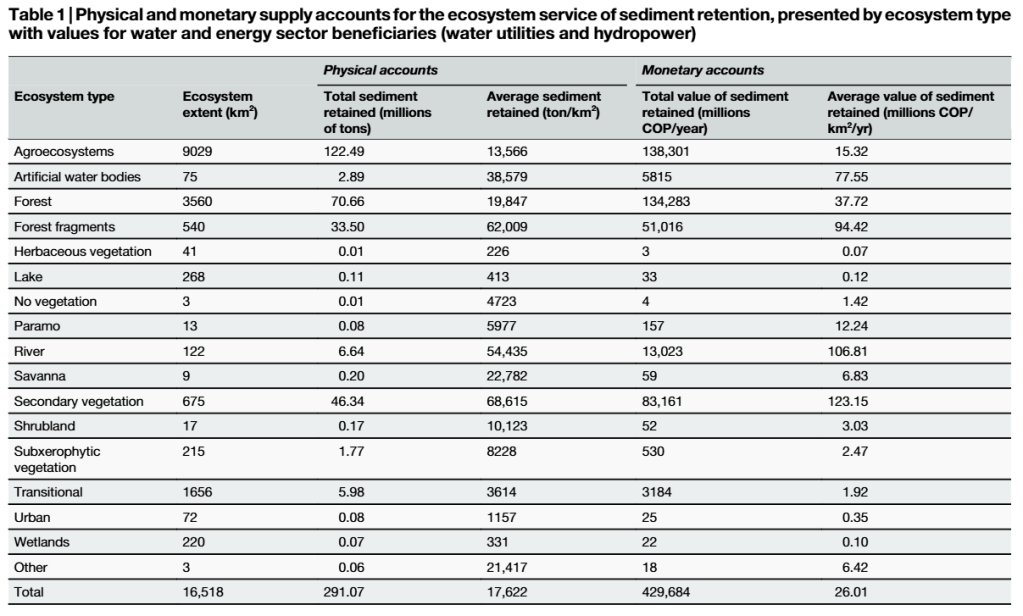
The list of natural assets, ecosystem services and monetary accounting from the study is as follow:
Economic value of sediment retention
1. Hydropower sector
Sediment retention services provided by upstream ecosystems prevent sediment buildup in the hydroelectric plant, helping maintain its energy generation capacity and extend its operational life.
This results in an estimated annual economic benefit of approximately 95 million USD. These savings stem from avoiding costly sediment removal, infrastructure degradation, and efficiency losses in hydropower production.
2. Water utilities
In the middle and lower parts of the basin, ecosystems help water utilities by reducing sediment in surface water, which lowers treatment costs and minimizes plant shutdowns due to turbidity. This sediment retention service yields an estimated 8.3 million USD in annual savings.
Utilities benefit from lower chemical and energy use, fewer service interruptions, and reduced revenue losses caused by operational downtime. When sediment levels exceed treatment capacity, utilities are forced to halt service, resulting in significant economic and social impacts, all of which are mitigated by ecosystem-based sediment control.
Implications of knowing the natural capital of the basin
The NCA found that sediment retention services in the Sinú River Basin provide an estimated combined benefit of around 103.3 million USD per year, with the majority going to the energy sector and a smaller, yet still significant, portion to water utilities.
This figure is equivalent to 1.7% of the region’s gross domestic product. Moreover, the planned expansion of the region’s aqueduct system would further increase these services’ value by 12% of the GDP.
The findings underscore the critical role that natural ecosystems play in supporting major infrastructure and public services, without any direct financial investment.
By quantifying ecosystem services in economic terms, the study provides a practical tool for guiding decisions in infrastructure, land use, and water management. It also demonstrates the potential for scaling up this approach both nationally in Colombia and internationally, offering a replicable model for integrating natural capital into economic and environmental planning.
 The Environment Consultant