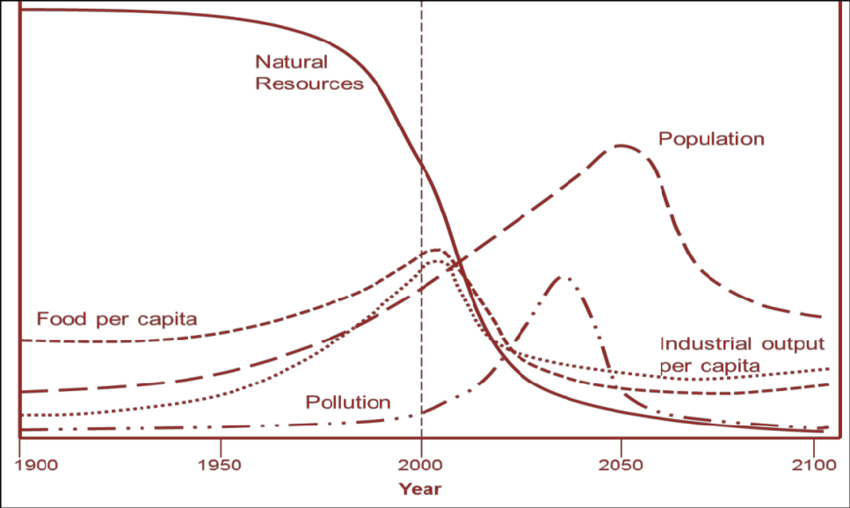
In 1972, a group of researchers published The Limits to Growth, a report that would forever change how the world viewed the relationship between economic growth and environmental sustainability.
Using powerful computer models, the authors predicted that unchecked population growth and resource consumption could lead to ecological collapse within a century.
Though controversial at the time, The Limits to Growth remains one of the most influential environmental works ever written, sparking debates that are still relevant today.
The book emphasized the finite nature of the planet’s resources and the limits of economic growth. The book changed the conversation around sustainability and influenced policy.
The premise
Published by the Club of Rome, a global think tank, The Limits to Growth was based on the results of a study conducted using a computer model called World3.
This model simulated the interactions between population growth, industrial production, environmental pollution, and resource depletion.
The conclusions were stark: if current trends of exponential growth continued, the planet would face severe shortages of essential resources such as food, water, and energy, eventually leading to a global collapse.
The book identified five key factors that were pushing the Earth to its limits:
- Population Growth: The rapid increase in the global population, especially in developing countries.
- Resource Depletion: The overconsumption of nonrenewable resources like oil, coal, and metals.
- Industrial Output: Increasing industrial production without regard for environmental impact.
- Environmental Pollution: The negative effects of pollution on ecosystems and the climate.
- Food Production: The challenge of feeding a growing population while managing limited arable land and resources.
Using these variables, the authors suggested that if growth in these areas was not slowed down, the world could face a “dieback” — a sharp, catastrophic decline in living standards and population levels due to the collapse of natural systems.
Out-of-the-box authors
The authors of The Limits to Growth were a team of scientists and researchers led by Donella Meadows, Dennis Meadows, and Jorgen Randers.
Donella Meadows, in particular, had a deep commitment to systems thinking, which views the world as a network of interconnected processes. She emphasized that human activities do not occur in isolation — they have ripple effects that can trigger cascading problems, such as environmental degradation and resource shortages.
The report was radical in its premise: that continuous economic growth was unsustainable in a world with finite resources. At the time of publication, this idea was not widely accepted.
Mainstream economists and politicians focused on the idea of infinite growth driven by technological innovation and market expansion. The Limits to Growth presented a stark contrast — it called for a rethinking of our economic models and a transition to a more sustainable approach.
Backlash
Upon its release, The Limits to Growth was met with significant criticism. Many economists, industrialists, and politicians rejected its predictions, arguing that technological advancements would solve resource shortages and pollution problems. They believed that market-driven innovations could continue to support growth indefinitely.
However, as the decades have passed, many of the book’s predictions have proven eerily accurate. Issues such as resource depletion, climate change, and environmental degradation are increasingly dominating global headlines.
Critics who once dismissed The Limits to Growth now acknowledge that its warnings were prescient, and the global conversation on sustainable development is only growing louder.
Still relevant
More than 50 years after its publication, The Limits to Growth remains a foundational text for those concerned with environmental sustainability and the future of human civilization.
The book’s key insights — the need to balance population, resource use, and environmental impact — have become cornerstones of modern environmental policy.
While global conditions have changed and some technological advances have alleviated certain pressures, the core message of The Limits to Growth still holds: the Earth’s resources are finite, and we must learn to live within its ecological limits.
In recent years, the book has gained renewed relevance as the world faces urgent issues like climate change, biodiversity loss, and resource depletion. The concept of sustainable development — the idea that we must meet our needs without compromising the ability of future generations to meet theirs — is now central to global policy discussions and international agreements.
 The Environment Consultant