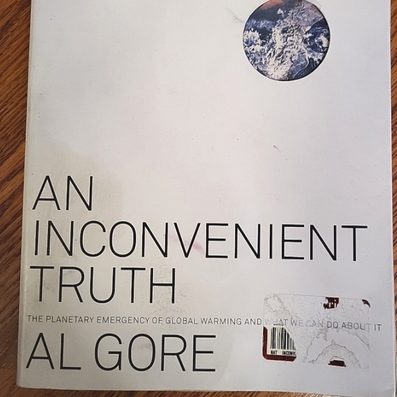
In 2006, a book and documentary combination shook the global consciousness. Al Gore’s An Inconvenient Truth brought climate change out of academic circles and into mainstream public discourse. It was more than just a warning — it was a cultural event, a call to action, and a turning point in how the world understood the environmental crisis.
Backed by scientific research, real-world evidence, and powerful visuals, An Inconvenient Truth pushed climate change into the political spotlight. It influenced legislation, inspired grassroots movements, and made “global warming” a household phrase.
When Climate Change became part of our vocabulary
At its heart, An Inconvenient Truth is a story of contrasts — between human progress and ecological cost, denial and urgency, inaction and responsibility. Through a mix of scientific data, charts, photographs, and personal anecdotes, Al Gore revealed the devastating impact of rising greenhouse gas emissions, melting glaciers, extreme weather, and disappearing species.
Unlike many policy-heavy environmental texts, Gore’s book connected deeply with the average reader. It simplified complex science without dumbing it down, making the realities of climate change relatable and emotionally resonant.
Gore wasn’t just telling us the Earth was warming — he was showing us what it meant for our homes, our food, our health, and our future.
Al Gore: From Vice President to Climate Advocate
Al Gore had long been involved in environmental issues. As a U.S. senator in the 1980s, he held hearings on climate change before it was widely acknowledged. As Vice President under Bill Clinton, he pushed for international climate cooperation, including support for the Kyoto Protocol.
But after the 2000 U.S. presidential election, Gore took on a different role: educator and advocate. He began delivering a climate-focused presentation to audiences around the world — the very presentation that became the basis for both the An Inconvenient Truth book and the Academy Award–winning documentary of the same name.
Gore’s unique position as both a political insider and a public communicator gave him a platform few others had. He used it not to scold, but to urge — for awareness, for change, and for action.
Global reaction and controversy
Al Gore didn’t invent the science of climate change — but he made it accessible. He didn’t act alone — but he showed that one person with knowledge, a platform, and a sense of purpose can shift the world’s attention. An Inconvenient Truth was a breakthrough moment in climate communication. It won an Oscar for Best Documentary, sold millions of copies, and was shown in classrooms and government offices around the globe. It played a pivotal role in getting climate change on the agenda of international summits, business leaders, and local governments.
But it wasn’t without backlash. Critics, especially in the fossil fuel industry and certain political circles, accused Gore of exaggeration and alarmism. Some challenged the accuracy of the science, while others took issue with Gore’s political background.
Still, much of the scientific community rallied behind the core message: the climate crisis is real, human-caused, and demands urgent action.
 The Environment Consultant