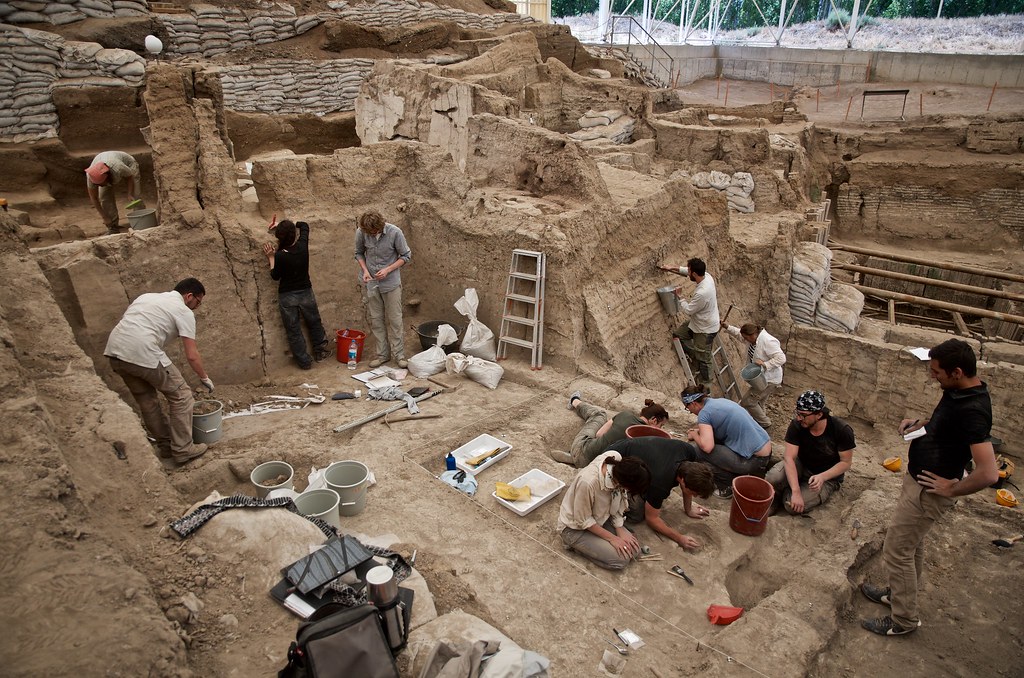
Archaeologists excavate ancient building in the Ruins of Çatalhöyük (Türkiye)
Heritage Impact Assessments (HIAs) are a tool to evaluate the potential impacts of potential development on cultural assets. Cultural heritage includes both tangible assets, such as monuments, buildings, and archaeological sites, and intangible elements, such as traditions, customs, and local knowledge. By evaluating these impacts, the HIA helps to ensure that cultural heritage is appropriately considered and preserved during the planning, design, and execution of a development project. The HIA also provides a mechanism for managing heritage-related risks and ensuring compliance with national and international cultural preservation standards.
The HIA process is similar to the ESIA process overview, but is tailored to the unique characteristics of cultural heritage. The following sections discuss the systematic approach followed for a HIA.
1. Screening and Scoping
The first phase involves screening to determine whether the proposed project could potentially affect cultural heritage. During this stage, the project’s location, scale, and scope are examined to identify heritage assets in the vicinity. If cultural heritage resources are present, the assessment proceeds to the Scoping phase.
Scoping establishes the specific cultural heritage values that need to be assessed, such as historic buildings, archaeological sites, sacred spaces, or intangible cultural practices. It also identifies stakeholders, such as local communities, cultural heritage experts, and government authorities, to ensure that the assessment considers a wide range of perspectives.
2. Baseline data collection
The next stage is the collection of baseline data to document the existing cultural heritage resources in the project area. This data can be gathered through a variety of methods, including site surveys, historical research, interviews with local communities, and consultation with cultural heritage experts. The goal is to create a comprehensive inventory of heritage assets, including their historical, social, and cultural significance.
Baseline data should not only cover tangible heritage (such as monuments or landscapes) but also intangible heritage, such as local customs, festivals, and traditions. This holistic approach ensures that the assessment captures the full spectrum of cultural heritage in the project area.
3. Impact assessment
The impact assessment phase involves evaluating how the proposed development may affect the identified heritage resources. This includes both direct and indirect impacts, such as:
- Physical damage: Destruction, alteration, or degradation of heritage sites, buildings, or artifacts.
- Visual impacts: Changes to the landscape or the visual integrity of heritage sites due to construction or operational activities.
- Social and cultural impacts: Disruptions to cultural practices, community identity, or access to heritage sites.
- Economic impacts: Potential loss of tourism or traditional industries tied to heritage sites.
To assess these impacts, both qualitative and quantitative data should be used, drawing from previous research, stakeholder input, and expert analysis. This phase also evaluates the significance of the impacts, considering factors like the rarity of the heritage asset, its historical importance, and the cultural value placed on it by local communities.
4. Mitigation and enhancement measures
Once potential impacts have been identified, the next step is to propose mitigation and enhancement measures to reduce negative effects on cultural heritage. Mitigation strategies can include:
- Avoidance: Modifying project plans to avoid heritage sites altogether.
- Preservation: Taking steps to protect and maintain heritage assets during construction and operation, such as stabilizing structures or using protective barriers.
- Restoration: If heritage sites are impacted, restoration or conservation work may be required to return them to their original condition.
- Cultural management plans: Developing management frameworks to safeguard intangible heritage, such as ensuring continued access to sacred sites or supporting the continuity of cultural practices.
In some cases, enhancement measures may also be implemented to promote the appreciation and understanding of cultural heritage, such as creating educational programs or heritage interpretation centers.
5. Monitoring and reporting
The final phase of the HIA process involves monitoring the ongoing impacts of the project on cultural heritage. This phase ensures that the mitigation measures are effective and that any unforeseen impacts are addressed promptly. Regular monitoring is especially important for long-term projects, where cultural heritage resources may be impacted during different stages of development.
Reports on heritage impact monitoring should be submitted to the relevant authorities and stakeholders to maintain transparency and ensure accountability. These reports also help refine management strategies if new impacts are identified.
Quick example
Archaeologists and heritage experts follow national and international regulations and guidelines, to assess the value assigned to a cultural asset. Depending on such categories, and on the magnitude of impact to an asset, the heritage experts evaluate the risk and mitigation measurements to be applied for that particular asset.
For example, archaeologists might find that the project site seats on a buried ancient village. This type of asset is unique, and often categorized as having the highest value within national regulations; therefore, they are strongly protected by law. With the project sitting on the ancient village, there is a major risk for destruction, and mitigation is unlikely to remove the risk. No construction is the only way to preserve the archaeological asset, requiring the project to be moved to another location.
On the contrary, archaeologists might find several rock drawings along a rocky terrain of the project site. These are likely to be abundant beyond the project area, hence this type of asset is categorized under regulations as of least concern when compared with the ancient village. Moreover, mitigation – such as translocating the rocks with the heritage art, could reduce the impact risk and preserve the value of the asset.
Conclusion
Integrating a Heritage Impact Assessment into the ESIA process is essential for ensuring that development projects respect and protect cultural heritage. Robust HIAs offer several key benefits:
- Cultural preservation: By identifying and mitigating potential impacts on cultural heritage, an HIA helps preserve valuable heritage resources for future generations.
- Sustainable development: Incorporating cultural heritage considerations into the development process promotes responsible and sustainable development practices that respect local cultures and traditions.
- Improved project acceptance: Engaging with local communities and stakeholders and addressing heritage concerns can help secure social acceptance and reduce opposition to the project.
- Compliance with regulations: Conducting a thorough HIA ensures that the project complies with legal and regulatory requirements related to cultural heritage, avoiding potential legal challenges or delays.
 The Environment Consultant