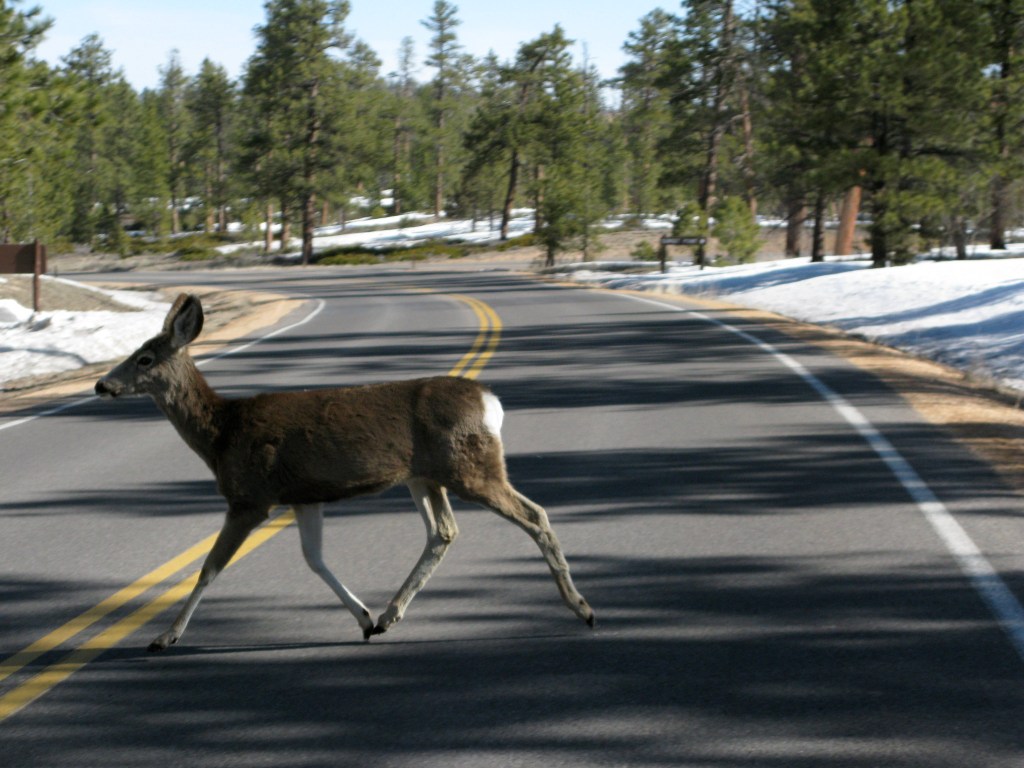
Deer crossing a road in Utah, United States.
Let’s consider a hypothetical scenario where a company plans to build a highway that will pass through a forested area. The primary concern here is the potential impact of the project on local wildlife and biodiversity, which are the ecological receptors.
1. Identification of Ecological Receptors
Ecological receptors are the living organisms, habitats, and ecosystem services that could be affected by the project. This could be plants and animals in the forest, some of which may be rare or endangered, as well as essential services like carbon sequestration, water filtration, and habitat provision.
During the ecological baseline assessment, environment consultants carry out an inventory of species based on background information and field surveys, and evaluate ecological considerations. During the baseline assessment, the ecologist might found an IUCN Red List Endangered species, and important habitats such as wetlands near the forest. The ecologist also observed that there are species sensitive to habitat fragmentation or disturbance.
2. Prediction of Potential Impacts
The next step is to predict how the project might impact these ecological receptors. This involves considering various stages of the project—construction, operation, and decommissioning—and evaluating the potential consequences on the identified ecological receptors.
- Habitat Loss: The construction of the highway may lead to the direct loss of forest habitat. This could disrupt local plant communities, including rare or endemic species that depend on the forest ecosystem.
- Fragmentation: The highway could fragment wildlife habitats, making it more difficult for species to access food, mates, and migration routes. For example, some species may rely on a continuous forest corridor, which could be disrupted by the highway.
- Pollution: During construction, dust, noise, and runoff from the construction site could affect both flora and fauna. For example, pollutants could alter the water quality in nearby riparian zones, impacting aquatic life and amphibians.
- Collision Risks: Once operational, the highway could pose a risk of vehicle collisions with wildlife, particularly mammals, which may not be able to avoid traffic in the area.
- Edge Effects: The creation of the highway’s edges could expose sensitive species to higher light levels, increased temperature, and the spread of invasive species.
3. Prediction of Likelihood and Severity
To assess these impacts, the likelihood of occurrence and the severity of each impact need to be evaluated. For this, the ecologist use the Risk Assessment Matrix to assign a score to both likelihood and severity.
For example, if the highway’s construction is expected to result in the loss of 30% of a key habitat for the IUCN Red List Endangered species, the impact might be considered of moderate severity (habitat loss) and unlikely to result in immediate extinction, but still highly disruptive.
However, the risk of vehicle collisions might be likely and major severity, especially for large species like deer, as highways often result in significant mortality for wildlife.
4. Evaluation of Significance
Once impacts are predicted, the next step is to evaluate the significance of each impact, considering the sensitivity of the ecological receptors and the scale of the potential damage.
For instance:
- Endangered species: If the species is already under threat due to habitat loss or other factors, the destruction of part of its habitat could be classified as major severity and have high significance. If the endangered species relies on mature forest and has low reproductive rate, even a moderate reduction in habitat could significantly affect the population.
- Wetlands: The potential alteration of water quality could be considered moderate severity, but if the riparian ecosystem is home to other threatened species, such as amphibians, the significance of the impact could be high.
- Fragmentation of habitats: For species that require large, continuous habitats (e.g., large mammals), fragmentation could be classified as major severity, especially if it disrupts migration corridors or breeding sites.
5. Mitigation Measures
To address the identified impacts, several mitigation measures can be proposed. These measures aim to reduce the severity or likelihood of adverse impacts on ecological receptors. Examples of mitigation strategies in this context might include:
- Wildlife crossings: Installing wildlife corridors such as overpasses or underpasses for animals to safely cross the highway, thereby reducing collision risks for large mammals, as well as minimizing habitat fragmentation.
- Pollution control: Implementing measures to minimize construction runoff and reduce contamination of nearby riparian zones. Installing silt fences or using eco-friendly materials can help protect aquatic life.
- Noise and light reduction: Planting vegetation along the highway to serve as sound barriers and reduce light pollution, which could help reduce the negative effects on nocturnal species.
- Monitoring: Continuous monitoring of wildlife populations and habitat conditions to track the success of mitigation measures and identify new potential risks during the project lifecycle.
As part of the impact assessment, ecologist should evaluate how the mitigation will reduce the risk and severity, and compare agains no-mitigation scenario. Both severity for each identified receptor shoud be reported within the ESIA.
6. Cumulative Impact Assessment
A cumulative impact assessment is necessary to evaluate how this project’s impact on ecological receptors will combine with other existing or proposed activities in the area. For example, if other infrastructure projects are underway in the same forest area, the combined impacts on species could be greater than the impact of any one project alone.
In this case, the combined effect of habitat loss from multiple projects might lead to a situation where the population of the endangered species is reduced to unsustainable levels. Cumulative impacts could therefore exacerbate the severity of impacts on the species, requiring more extensive mitigation measures.
7. Reporting and Decision-Making
The findings from the ecological impact assessment would be included in the final ESIA report. The report would present the predicted impacts on ecological receptors, evaluate their significance, and outline the proposed mitigation measures. This comprehensive report would guide decision-makers in determining whether the project can proceed, and if so, under what conditions.
 The Environment Consultant