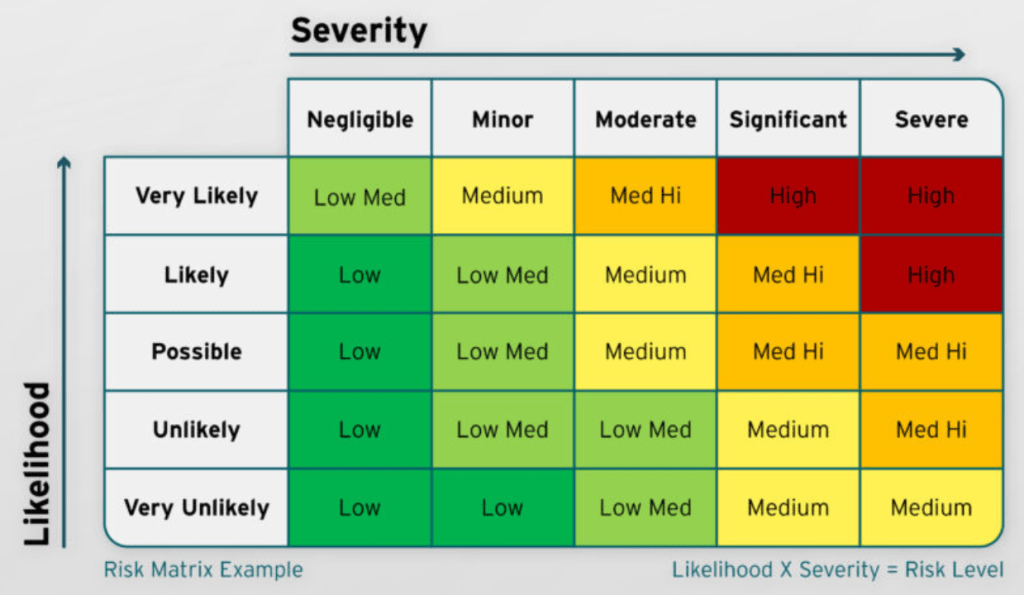
A fundamental tool in the impact assessment process is the Risk Assessment Matrix, which is used to evaluate the severity and likelihood of potential impacts. This matrix serves as a systematic method to prioritize impacts based on their potential consequences and the probability of their occurrence. By categorizing risks in this way, the matrix helps environment consultants identify which impacts require immediate attention and resources, ensuring that the most significant risks are addressed proactively.
1. Structure of the Risk Assessment Matrix
The Risk Assessment Matrix typically consists of two axes:
- Likelihood (or Probability): This axis evaluates the probability of an impact occurring. It generally ranges from “rare” (very unlikely) to “almost certain” (very likely to occur).
- Severity (or Consequence): This axis assesses the potential consequences or magnitude of the impact if it does occur. It ranges from “insignificant” (negligible impact) to “catastrophic” (severe, irreversible impact).
Each impact is scored on these axes, resulting in a matrix that allows for a quick visual representation of the relative risk of each identified impact.
2. Likelihood Categories
The likelihood axis typically consists of the following categories:
- Rare or Very Unlikely: The impact is unlikely to occur during the life of the project, with a very low probability (e.g., less than 5%).
- Unlikely: The impact could occur, but it is not expected to happen frequently (e.g., 5-25% likelihood).
- Possible: There is a reasonable chance the impact will occur during the project’s lifecycle (e.g., 25-50% likelihood).
- Likely: The impact is expected to occur at some point, possibly with a high frequency (e.g., 50-75% likelihood).
- Almost Certain or Very Likely: The impact is very likely to occur, with a probability of more than 75% during the project’s lifecycle.
3. Severity Categories
The severity axis categorizes the potential consequences of an impact:
- Insignificant or Negligible: The impact would be minimal, causing no lasting damage or disruption. It could be easily reversed or mitigated with minimal effort or cost.
- Minor: The impact could lead to slight disruption, but it would not be significant in terms of environmental, social, or economic consequences. It may require some mitigation efforts.
- Moderate: The impact could result in noticeable environmental or social changes, requiring substantial mitigation or management measures. However, these impacts can generally be managed with proper intervention.
- Significant or Major: The impact would have significant consequences, potentially leading to irreversible damage to the environment or significant social disruption. Extensive mitigation efforts would be necessary.
- Severe or Catastrophic: The impact would have severe, long-term consequences that could lead to environmental degradation, loss of biodiversity, or significant harm to local communities. These impacts may be impossible to reverse and would require comprehensive and ongoing mitigation efforts.
4. Risk Evaluation
Once the likelihood and severity of each impact have been determined, the resulting classification helps prioritize risks based on their potential severity and probability, guiding decision-makers toward the most critical issues.
5. Risk Priority and Mitigation
The risk assessment matrix helps to identify which impacts should be prioritized for mitigation. Impacts that fall into the Med Hi or High risk zones on the matrix (e.g., Major or Catastrophic severity combined with Likely or Almost Certain likelihood) typically demand immediate attention and the development of comprehensive mitigation strategies.
For impacts that are categorized as low risk (e.g., Insignificant severity and Rare or Unlikely likelihood), it may be determined that they do not require intensive mitigation efforts, but should still be monitored to ensure they do not escalate.
By using the risk assessment matrix, the project team can ensure that limited resources are directed toward managing the most significant and likely risks, leading to more effective environmental and social management plans.
Conclusion
The use of a Risk Assessment Matrix in the impact assessment process enhances the objectivity and effectiveness of the evaluation. By systematically assessing the likelihood and severity of potential impacts, the matrix provides a clear visual guide for prioritizing risks and implementing mitigation measures. This tool helps ensure that the project’s environmental and social consequences are appropriately managed, contributing to more sustainable and responsible development.
 The Environment Consultant