Screening purpose
The Environmental and Social Impact Assessment (ESIA) process is an essential procedure aimed at identifying, assessing, and mitigating potential environmental and social risks of a project. One of the fundamental phases in this process is the ESIA Screening phase, designed to evaluate whether a proposed project or development may lead to significant environmental or social impacts.
Its primary objective is to determine if a full ESIA should be conducted, based on the project’s scope, potential environmental effects, and the level of intervention required. This step helps to avoid unnecessary assessments for projects unlikely to have significant consequences, optimizing resources and time. In cases where significant risks are identified, the project proceeds to a more detailed ESIA process.
This phase ensures that projects with the potential to cause adverse effects on ecosystems, communities, and resources are flagged early in the planning stages. Furthermore, it provides a framework for making informed decisions regarding the need for a comprehensive evaluation.
Parties involved in the ESIA preparation
An ESIA is typically required by project developers — individuals, companies, or organizations planning a project that may have significant environmental or social impacts. Project developers require a third party entity — environment consultancy authorized by the local authority, to carry out the ESIA. This third party entity consist of a team of environmental consultants, social experts, engineers, legal advisors, and other specialists.
The ESIA is prepared for the regulatory authorities — such as environmental protection agencies or relevant ministries, responsible for assessing and approving the project.
Methodology
The ESIA Screening process involves a structured review of the project proposal to evaluate potential risks and impacts. This phase typically includes the following steps:
1. Review of project description: The project developer submits a detailed description of the proposed development, including its location, scale, and scope of activities. This document is crucial for understanding the environmental context in which the project will operate.
2. Initial impact assessment: Environmental consultants analyze the preliminary information to identify any obvious environmental or social risks, such as air pollution, water use, habitat disruption, or socio-economic consequences. Depending on the available information, this assessment often involves preliminary site visits, data collection, and reviewing similar past projects.
When more information is needed, the environmental consultants submit to the project developer an RFI — Request for Information.
3. Screening criteria application: The screening information is submitted to the authorities as an official application — via the regulator’s website. The application consist on filling up a form and uploading relevant documents. Depending on the regulator, this step is done by the project developer, or by the consultant on behalf of the developer.
The form has a set of predefined criteria, often outlined by local or international guidelines, to evaluate the project’s environmental and social significance. These criteria typically cover aspects such as the scale of the project, proximity to sensitive areas (e.g., protected zones, water bodies), and the nature of the potential impacts (direct or indirect, short-term or long-term).
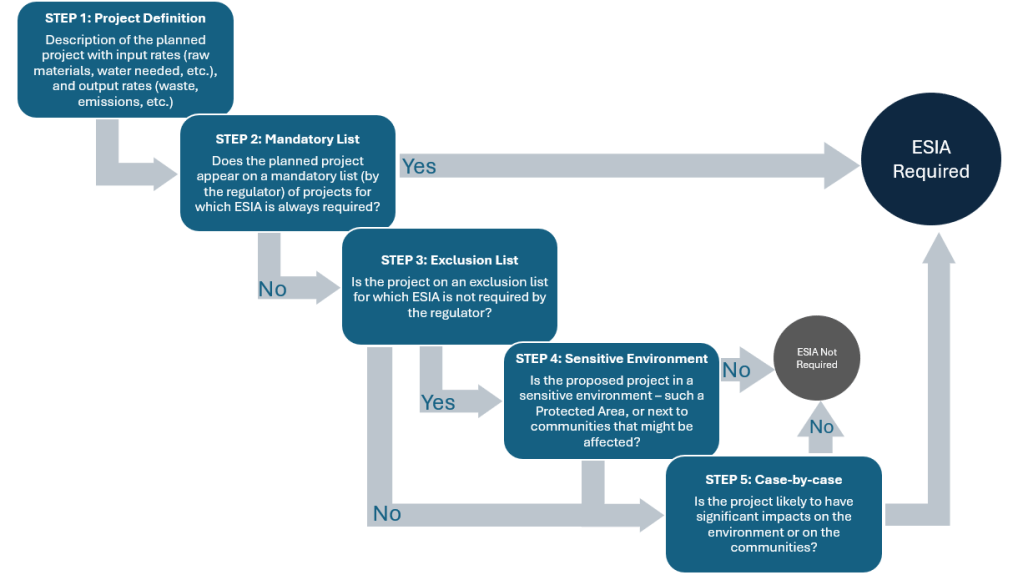
Typical screening review of project’s information for ESIA decision-making. Adapted from WBCSD’s ESIA Guidelines.
4. Decision-making: Based on the screening results, the environmental consultant, in collaboration with the authorities, makes a decision on whether a full ESIA is necessary. If deemed unnecessary, the project may be granted an approval with minimal requirements. If a full assessment is recommended, the project proceeds to the next stage, ensuring thorough analysis and risk mitigation.
Relevance of the Screening phase
The ESIA Screening phase may seem like a simple step, but its role in ensuring sustainable development cannot be overstated. It sets the stage for a responsible and robust environmental assessment process, ensuring that projects are carefully scrutinized to minimize adverse effects on the environment and society.
The Screening phase is crucial to identify potential environmental and social challenges early on, preventing costly delays, and ensuring that projects are appropriately assessed before moving forward. It serves as the foundation for more in-depth analysis in the subsequent phases of the ESIA process, providing a clear direction for mitigating impacts and designing sustainable solutions.
 The Environment Consultant