The most essential stage of the Environmental and Social Impact Assessment (ESIA) is the impact assessment itself. This phase plays a pivotal role in understanding, predicting, and mitigating the potential negative effects of a proposed project, ensuring that sustainable development is achieved. This article focuses specifically on the impact assessment process within the ESIA framework.
1. Identification of Potential Impacts
The first step involves identifying the potential environmental and social impacts of the proposed project. These impacts can be direct, indirect, cumulative, or transboundary and may affect various aspects of the environment, such as air, water, land, and biodiversity, as well as human health, livelihoods, and social structures.
The identification of impacts is carried out through a combination of data collection, literature reviews, and input from stakeholders. This step aims to capture both positive and negative consequences of the project, considering various phases of its lifecycle, including construction, operation, and decommissioning. It is critical to assess not only the immediate effects but also those that may manifest over the long term.
2. Prediction of Impact
Once the potential impacts are identified, the next step is to predict their magnitude, duration, and significance. This involves evaluating how the identified impacts will occur and assessing the extent (magnitute and duration) to which they may affect the environment or society. The prediction of impacts is based on scientific data, models, expert judgment, and sometimes predictive tools designed for specific environmental components such as air quality modeling or hydrological assessments.
Evaluating the significance of the predicted impacts is a central component of the impact assessment. Not all identified impacts will be significant, and this evaluation process helps prioritize those that require mitigation or further investigation. The significance of an impact is typically determined by considering both its magnitude and the sensitivity of the affected receptor (e.g., an endangered species or a vulnerable community).
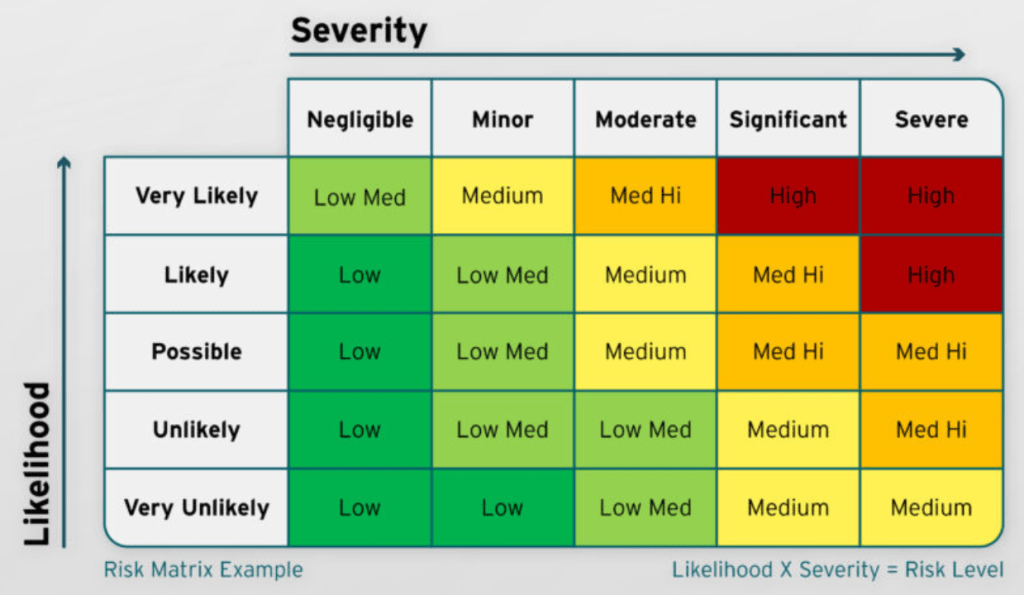
Environment consultants usually use a Risk Assessment Matrix as a systematic method to prioritize impacts based on their potential consequences and the probability of their occurrence. The matrix allows placing impacts into risk categories, based on their likelihood to occur (unlikely to almost certain to occur), and on the severity of the impact (negligible to severe or irreversible).
3. Mitigation Measures
Following the evaluation of impact significance, the next step is to propose mitigation measures aimed at avoiding, minimizing, or compensating for the adverse effects of the project. The goal of mitigation is to reduce the negative impacts to a level that is acceptable or manageable, while promoting positive outcomes where possible. These measures may include design modifications, alternative technologies, timing adjustments, or compensation mechanisms such as habitat restoration or community development programs.
Mitigation can be classified into different categories, including:
- Avoidance: Altering project designs or practices to prevent adverse impacts entirely.
- Minimization: Reducing the extent or severity of the impact.
- Restoration: Reversing or compensating for impacts after they occur.
- Offsetting: Providing benefits to offset unavoidable impacts, often in the form of environmental conservation or community development initiatives.
The effectiveness of proposed mitigation measures should be carefully evaluated to ensure they address the identified impacts and meet regulatory or stakeholder expectations. An important aspect of this phase is the development of a monitoring program to track the success of mitigation strategies throughout the project lifecycle (this is further developed into the Environmental Management Plan as part of the ESIA Report).
4. Cumulative Impact Assessment
Cumulative impacts refer to the combined effects of the project in conjunction with other existing or planned activities in the region. These impacts may not be significant individually but could become so when considered together. For example, multiple projects in a region may contribute to air pollution, water scarcity, or ecosystem degradation in ways that are not immediately apparent.
Cumulative impact assessments are particularly challenging as they require a comprehensive understanding of all relevant projects and activities in the area. These assessments help ensure that the total environmental and social burden is properly considered, facilitating decision-making that accounts for long-term sustainability.
5. Stakeholder Involvement
An essential aspect of the impact assessment process is stakeholder involvement. Engaging with local communities, government authorities, and other interested parties helps to ensure that the potential impacts of the project are fully understood and that local concerns are taken into account. Stakeholders often provide valuable insights into local environmental conditions, social structures, and potential risks that may not be fully captured by technical assessments alone.
Conclusion
The impact assessment is a core component of the ESIA process, providing the framework for evaluating and managing the environmental and social consequences of a proposed project. By identifying, predicting, and evaluating impacts, and implementing appropriate mitigation measures, the impact assessment helps ensure that projects contribute to sustainable development, minimizing harm while maximizing benefits to both the environment and local communities.
 The Environment Consultant